
Power Mapping: A Tool for Liberatory Pedagogy
I tried power mapping for the first time with high school seniors. It inspired one of them to start a movement in their school.

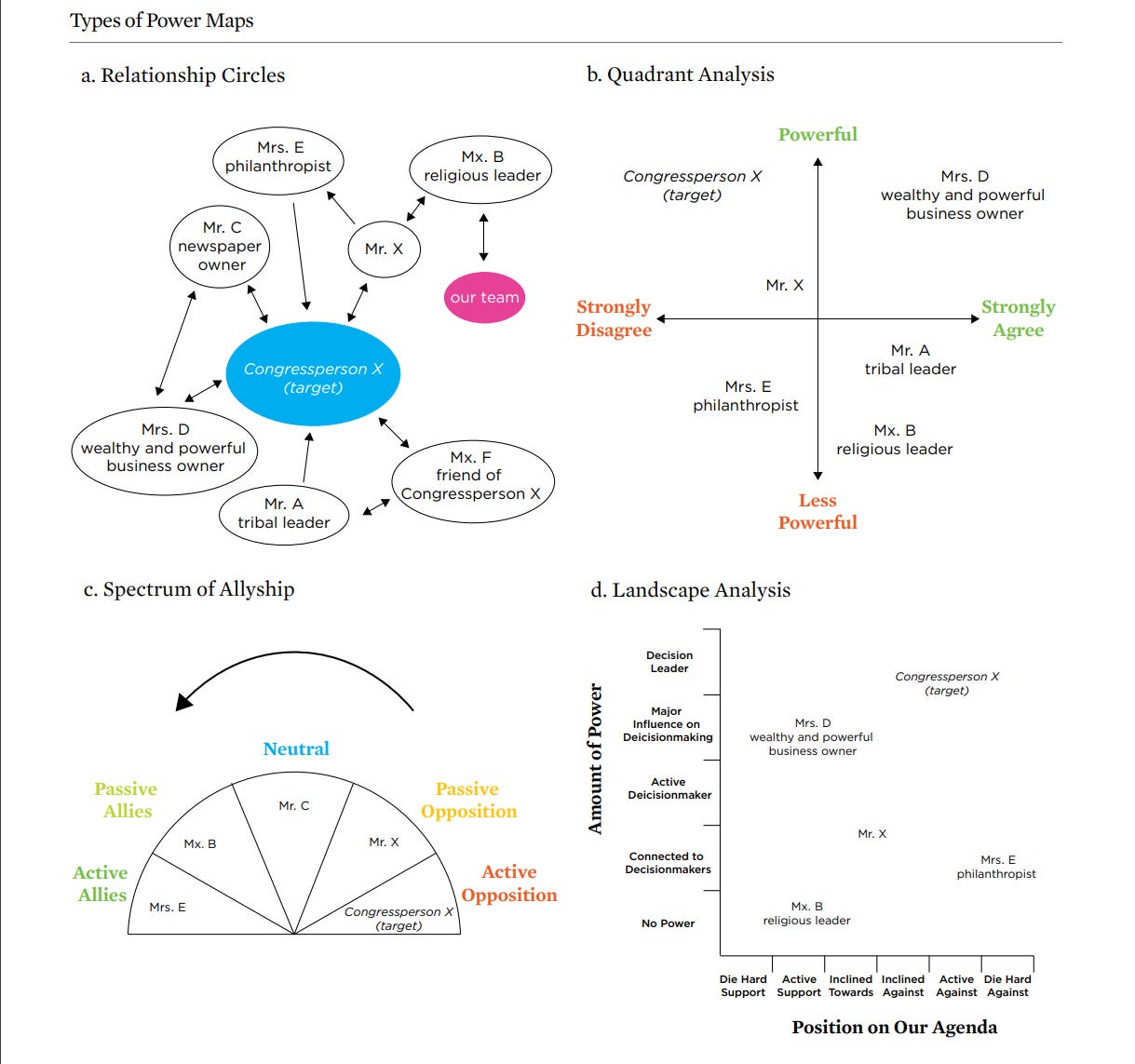
I teach a three-week summer Education Technology course for rising high school seniors in Georgetown University’s Summer College Immersion Program (SCIP). My course is one of two that students take in the three weeks they’re on campus, in addition to college prep workshops and other programming. Despite the course being just three weeks, we have 14 hours of classroom time.
In Summer 2024, I decided to do something different: instead of having students start their final projects by thinking about their topics independently and then doing lightning talks in small groups to exchange peer feedback, I used power mapping, which I hoped would teach students to do the following:
Demonstrate the relationship between stakeholders in a complex system, like a school district or neighborhood, and the power those stakeholders have relative to each other.
This helps students realize that rational decision-making often takes a backseat to power dynamics and competing interests, and that being a skilled practitioner in ed tech requires strong communication, advocacy, and analysis skills to navigate these bureaucracies.
Articulate wicked problems in their schools and school districts.
I encourage students to go, as I often say, three 'whys' deep. Yes, your school doesn’t have enough laptops because the district doesn’t have enough money for them. But why doesn’t the district have enough money for them? And to that answer, why?
Design solutions to the wicked problems they’ve identified by first considering the fears and motivations of all stakeholders involved.
They learn how to investigate unfamiliar stakeholder perspectives—such as superintendents, chief technology officers, parents other than their own.
Execute those solutions through the skills we learn in the class.
These skills include learning design, learning space design, quality assurance, instructional communication, and critical technology analysis.
We started the activity in session 3, where students were randomly assigned to small groups. I asked a student from each group to volunteer. The group would be designing their power map based on the volunteering students’ school district. After 2.5 total hours of discussing technology-related problems faced by students, teachers, leadership, and other stakeholders (and who might be responsible for those problems), something magical happened.
At the end of class, as students were packing up, one approached me and said, “Mr. Davis, that was actually a really helpful activity. I didn't know that I was that passionate about education.”
“I didn’t know I was passionate about _______.” Isn’t that a dream statement that every educator wants to hear from their students? During the last class of the summer session, the same student proudly walks over to me with their laptop. On their screen was a Google form in one tab, and a Gmail inbox in another. The Google form was a petition to reinstate a library in their school. They showed me two email chains: one to their principal, who fully supported the initiative, and another with dozens of replies from students in their school, cheering on the effort. The fact that they’d received such quick, enthusiastic responses in the middle of July made this even more impressive.
Through our power mapping exercise, this student dug deeper into exactly why a library was taken out of their school a few years prior. This student resided in Florida, which has become a national hotbed for bans on phones, DEI programming, books, and the libraries that once held these books. Old school libraries end up becoming everything from detention halls to extra storage space to additional classroom space.
The 2.5-hour activity helped a student reframe a problem they’d mulled over since ninth grade. Their takeaway: it actually wasn’t the principal who was responsible for implementing the removal of the library. Since this was a charter school, the org chart wasn’t as straightforward as that of a traditional public school district. She made plans to share the results of the petition with parents and the governing board of the charter school network to get things moving. Their goal: to see plans for reinstating a library crystallize before they graduated that following June.
The thing I love most about power mapping is that it epitomizes culturally-responsive teaching. Students bring not just topics, but problems into the classroom. Problem-centered design is such a powerful teaching and learning design strategy because anything can be framed as a problem, depending on the perspective that the learner is viewing the issue from and the words they use to articulate it. What might be a problem for students might not be a problem for a superintendent, and vice versa. In fact, challenges that students face might actually serve leadership. Once students are given the opportunity to dissect these power dynamics—especially as they play out in real time in their communities—they take it and run with it.
In a matter of two weeks, a high school senior taking a college-level course identified a final project that they were excited about and well-equipped to complete, a process that would take several weeks in your typical 18-week undergrad class. Designing this activity to begin as an in-class group project and evolve into an individual final project strikes a balance between peer collaboration and individual evidence of skill development. The activity introduced a new way of thinking about problems, a process that they can replicate in the future.
Let’s revisit some of the learning outcomes that this activity met:
Demonstrate the relationship between stakeholders in a complex system, like a school district or a neighborhood, and the power those stakeholders have relative to each other.
Articulate wicked problems in their schools and school districts.
Design solutions to wicked problems by first considering the fears and motivations of all stakeholders involved.
Execute those solutions through skills we learn in the class: learning design, learning space design, quality assurance, instructional communication, and critical technology analysis..
This article is the first in a three-part series. Read article two below.

This is a very interesting read, I love deeper level thinking and collaborative learning amongst students. The fact finding, problem solving and resolution and independence of this project. Students were not just identifying the problems and cause & effect but they used the information and applied their findings in a way to benefit their schools and communities.
They were passionate about identifying next steps and taking the initiative to get key individuals into action. This is sheer brilliance. I see future leaders!! I
absolutely love this!!
Kudos to you and your students Mr. Jordan Davis.
So grateful I found your newsletter! This is important work you are putting out. I love your point about looking three whys deep. I am a community psychology doctoral student and tenant organizer and I often see folks getting stuck on surface-level analysis of the issues we are facing, which can lead to a mentality of "that is just the way things are" particularly when thinking about budget-related issues. But power mapping is so useful in pointing out that actually, there are real people making decisions that prevent progress at best and cause harm at worst. I have found it difficult to bridge the gap between organizing and academia, but you laid out your process so well. If it's ok, I am going to share your newsletter in our open-source database (https://scra27.org/resources/educators/knowledge-hub/)in hopes others in my field can utilize it.